
Speculative wearable + app · 2026
Nexo
StatusHackathon concept · Figma Build 2026, 72 hours
You feel it. But you can’t explain it.

- Problem
- When a room turns tense, people feel it but can’t tell why, so they blame themselves and leave.
- What I did
- As design lead on a team of four at the 72-hour Figma Build 2026 hackathon, I designed the app architecture, core screens, and design system for a scent-based wearable.
- Result
- A wearable and app concept that confirms what you sense instead of calming you. The scent vocabulary itself isn’t prototyped yet.
- 72 h
- hackathon
- 4
- designers
- 4
- core screens
- 4
- emotions in the taxonomy
My part
- App architecture
- How the four core screens connect
- Core screens
- Live Scene, Calibration, Memory, and Settings
- Design system
- Recursive typography and a four-emotion color taxonomy
Built in 72 hours with Li, Ning, and Liu.
Problem
Three failures compound.
We constantly read emotional signals from the people around us, below conscious awareness. You feel a room shift and never learn why.
01
Feeling without cause.
You sense a space is tense or off but can’t point to what changed. The signal arrives with no explanation.
02
Self-blame in the gap.
Unable to find the cause outside themselves, people assume it’s them, withdraw, and feel guilty for leaving.
03
Quietly exhausting.
For socially anxious or neurodivergent people, a constant stream of unexplained signals drains a whole evening’s energy.
Concept direction
Exploring a direction through a speculative persona.
Mika Lin is a speculative persona created by the team, not an interview participant. Imagined transit, café, and market scenarios helped us explore separating personal stress from the atmosphere of a place.
Published research behind the premise. Two published findings shaped the two sensing streams. Sweat from people under emotional stress, compared with sweat from exercise, activated the amygdala of the people who smelled it (Mujica-Parodi et al., PLoS ONE, 2009). And a cinema’s air shifted at the same scenes in every screening of a film, as audiences breathed out different compounds during moments like suspense (Williams et al., Scientific Reports, 2016). These studies do not validate Nexo’s emotion sensing or classification.

How the direction changed
- 01Speculative persona
Mika Lin, 28, a landscape architect with ADHD
- 02First framing
“Reduce my stress”
- 03Three scenes
A transit hub, a café, an abandoned market run: imagined situations for exploring the concept
- 04Reframe
“Confirm my perception”: explain the room, don’t calm the person
The problem was never the feeling. It was the missing explanation.
System & app
Make the invisible perceivable.
Speculative premise: Nexo reads a room’s emotional signals and turns them into a gentle cue now and a record you can read later. It doesn’t tell you to calm down. It confirms what you already sensed.

1 · Sense
Two streams.
A nose clip reads your skin and the air around you.
2 · Interpret
On device.
A private model reads the emotional signature.
3 · Feed back
Scent now, app later.
A gentle scent rhythm in the moment; the app to see and reflect.
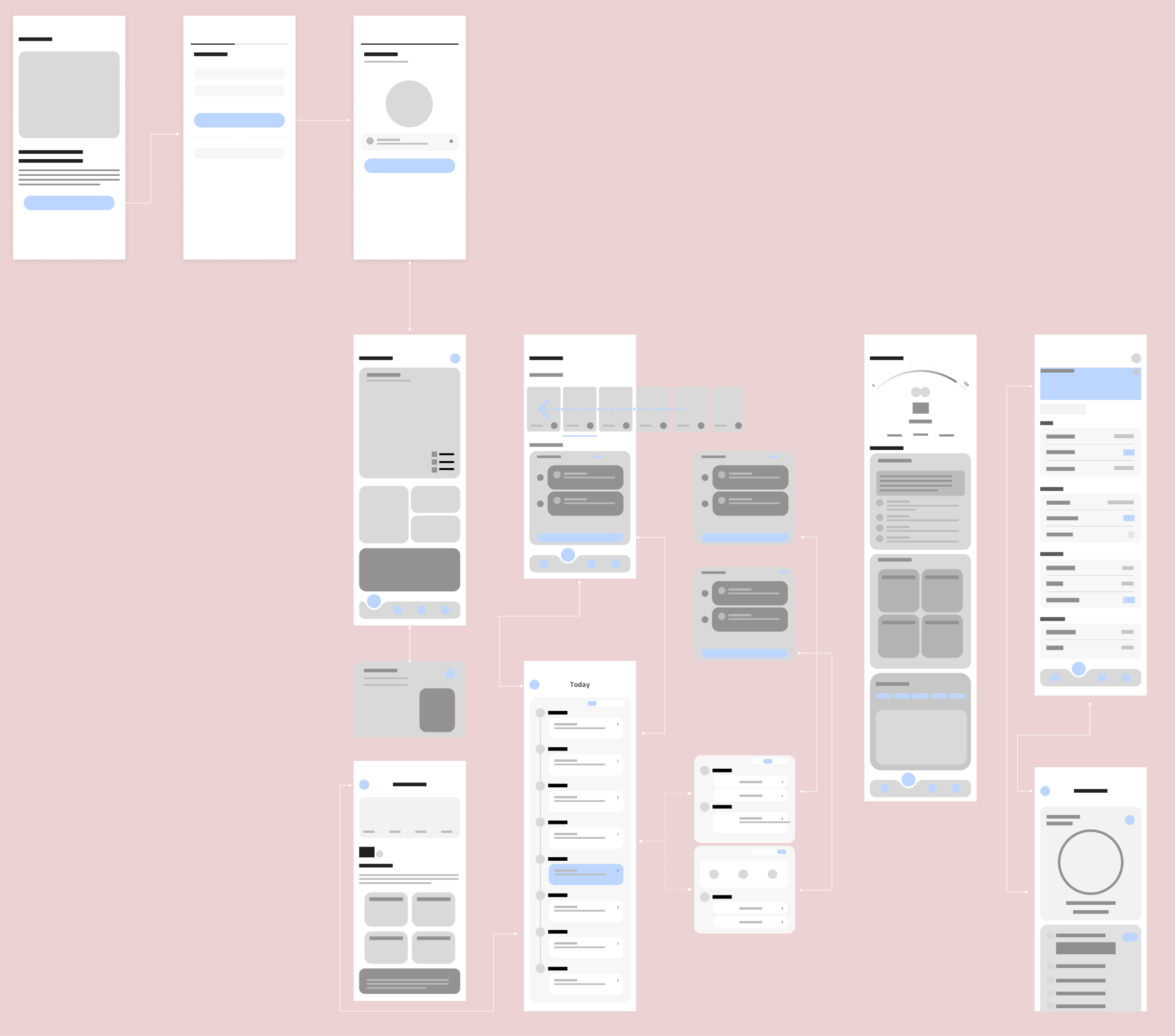
Live Scene
Your stress and the room’s, kept apart.
The home screen leads with the atmosphere itself, the crowd rendered in emotion color, and puts numbers second. The decisive call: separating the room’s stress (9) from your own (27).

Calibration
The device learns you.
An emotion sensor that doesn’t know you is just a mood ring. Calibration is an ongoing loop (measure, explore, confirm, improve) where your feedback visibly shapes the model.
TradeoffScreen data (93% · 217 days) is illustrative of a mature usage state.

Memory
Moments become a map.
One reading tells you about now; Memory tells you about your life. A daily timeline logs each place with its mood, and a monthly view rolls it into an emotion breakdown.

Settings
Privacy, in plain reach.
On-device storage by default. Location tracking as a visible toggle. Delete-all-data in the main list, not buried three menus deep. In a hackathon sprint the quiet screens get skipped first; we built them anyway.

Design system. The interface stays monochrome and precise, set in Recursive. Emotion colors distinguish calm, joy, anxious, and angry; supporting interface accents also appear in the screens.
What I learned
Confirmation mattered more than calm.
Designed interface / unproven sensing
- InterfaceFour core screens and their connected flowTest whether people can distinguish the room signal from their own
- Sensing premiseA device concept reading skin and surrounding airThe cited studies do not establish that this device can classify emotions in real rooms
- Scent feedbackA cue now, reflection in the app laterPrototype the scent vocabulary and how people interpret it first
Write the need as one sentence.
We started out designing to reduce stress, then realized people wanted to know they weren’t imagining it. Now I write the user’s need as one sentence before I pick features, and rewrite it when the evidence shifts.
The key decision was one distinction.
Splitting the room’s stress from your own made Live Scene useful. The design hinged on the one thing the user can’t separate on their own.
The quiet screens carried the trust.
Delete-all-data and on-device storage are the screens a hackathon usually skips, and they made the concept believable. Now I design privacy and exit screens in the first pass.
We designed the app around a signal we never defined.
What an “anxious room” feels like as a scent rhythm is still notional, and it’s the actual new sense. Now I prototype the riskiest unknown first, even roughly.
What’s next
The honest gaps
- Prototype the scent vocabulary itself
- Test how bystanders feel about being sensed
- Stress-test a four-emotion taxonomy against messier real rooms